
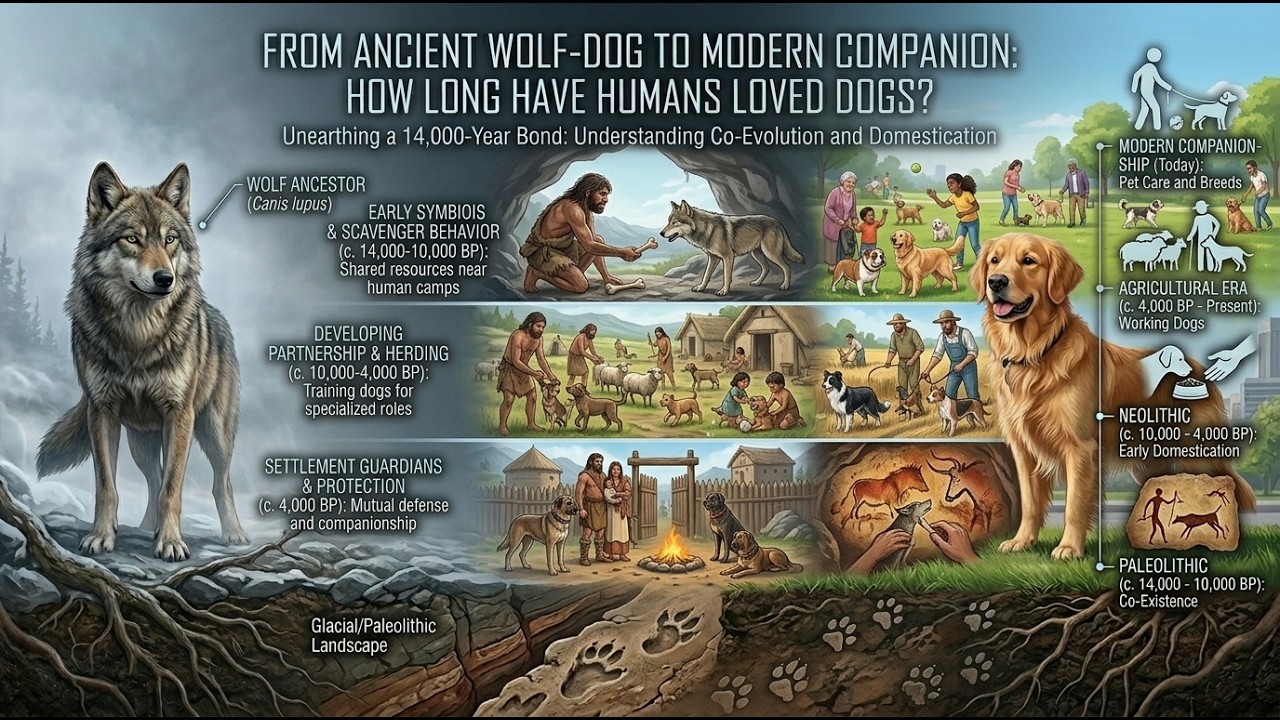
Humans and dogs have been together for at least 14,000 years, and likely much longer. The oldest widely accepted dog burial is the Bonn-Oberkassel dog, found in Germany and dated to about 14,200 years ago. Genetic and archaeological evidence suggests that the human–dog bond may have begun 20,000 to 30,000 years ago, or possibly earlier.
For people in the United States, this story has a later chapter. Ancient dogs arrived in North America with human groups thousands of years ago. One of the oldest known dog burials in the United States comes from the Koster site in Illinois, where a dog was buried about 10,000 years ago.
The exact date is still debated. Ancient bones can be hard to classify, and “wolf,” “early dog,” and “domesticated dog” do not always leave clear signs in the fossil record.
The short answer: at least 14,000 years, probably longer
The safest answer is more than 14,000 years. That date comes from a dog burial at Bonn-Oberkassel, near Bonn, Germany.
The dog was buried with two humans. Its burial suggests more than a practical link, such as hunting or guarding. The animal may have been cared for during illness and then buried as part of a human funeral practice.
Still, this does not prove that dog domestication began 14,200 years ago. A burial is simply the oldest clear evidence we have for a dog living closely with humans. The relationship may have started much earlier.
Why scientists give a range
Researchers use several types of evidence:
- Archaeological remains: bones, teeth, burials, and settlements
- Ancient DNA: genetic links between early dogs and modern dogs
- Changes in body shape: smaller skulls, shorter snouts, and other traits
- Human settlement patterns: signs that wolves or early dogs lived near people
- Behavioral clues: feeding, care, and intentional burial
These clues do not always point to the same date. A wolf-like animal may have lived near humans without being a domesticated dog. A dog-like skull may also belong to a wolf population with unusual traits.
For that reason, scientists usually separate three questions:
- When did wolves and humans first interact?
- When did some wolves begin living near human camps?
- When did those animals become dogs?
The first may have happened long before the third.
A timeline of the human–dog relationship
The timeline below shows the main evidence without treating uncertain dates as settled facts.
| Evidence or event | Approximate date | What it tells us |
|---|---|---|
| Possible early dog-like remains in Eurasia | 36,000–14,000 years ago | Some ancient remains may represent early dogs, but classification is debated |
| Genetic separation of dog and wolf lineages | Often estimated at 20,000–40,000 years ago | Dogs and wolves began following separate population histories |
| Dogs living with humans in the Ice Age | Possibly 20,000–15,000 years ago | Human camps may have supported early dog populations |
| Bonn-Oberkassel dog burial | About 14,200 years ago | Clear evidence of dogs living and dying in close human communities |
| Dogs spread across North America | At least about 10,000 years ago | Ancient dogs traveled with human groups into and across the continent |
| Farming and village life expand | About 12,000–7,000 years ago | Dogs took on more roles in settled communities |
| Modern dog breeds develop | Mostly within the last few thousand years | Selective breeding produced specialized body types and behaviors |
The dates are approximate. Radiocarbon dating gives an age range, not always one exact year. Genetic estimates also depend on the samples and methods used.
Did dogs come from wolves?
Yes, modern dogs descended from ancient wolf populations. However, dogs did not necessarily come from the gray wolves living in a nearby forest today.
The wolves that gave rise to dogs may have belonged to extinct or highly changed populations. Modern wolves and dogs share a common past, but modern wolves are not simply “undomesticated dogs.”
How domestication may have started
Scientists have proposed several models for dog domestication.
The camp-following model
Some wolves may have approached human camps to eat scraps. The least fearful animals would have gained access to food. Over many generations, natural selection could have favored wolves that were calmer around people.
The human-guided model
Humans may have captured, raised, and selected wolf pups. People could have kept animals that were useful for hunting, warning of danger, carrying loads, or providing companionship.
The two-way relationship model
The most likely explanation may include both processes. Wolves gained food near people, while humans gained useful partners. Over time, the animals and people shaped each other’s lives.
Domestication was probably not one event. It may have been a long process with repeated contact between different human and wolf populations.
What is the oldest evidence of a dog?
The Bonn-Oberkassel dog, dated to roughly 14,200 years ago, is one of the strongest examples of an early domesticated dog.
The dog had a serious illness that would likely have caused pain and weakness. Researchers have suggested that it survived because people fed and cared for it. That interpretation is reasonable, but it cannot be proven with complete certainty.
Other remains are older but more difficult to interpret.
Older dog-like remains
Researchers have studied specimens from places such as:
- Goyet Cave in Belgium, dated to roughly 36,000 years ago
- The Altai Mountains, with a dog-like canid dated to more than 30,000 years ago
- Razboinichya Cave in Siberia, with remains often discussed in early dog research
- The Paleolithic site of Předmostí, where dog-like canids appear among human remains
Some of these animals may have been early dogs. Others may have been unusual wolves or populations that later disappeared.
This distinction matters. A specimen can look different from a typical wolf without being part of the direct line that led to modern dogs.
Why bone shape is not enough
Ancient wolves and dogs varied in size and shape. Diet, climate, age, injury, and local ecology could all change an animal’s bones.
Scientists therefore compare several clues:
- Skull shape
- Tooth crowding
- Jaw size
- Body size
- Genetic data
- Burial context
- Association with human settlements
No single clue settles the entire question.
When did dogs arrive in North America?
Dogs were living in North America by at least 10,000 years ago, and likely earlier.
Ancient dogs traveled with human groups. They were not native descendants of modern North American wolves. Before European colonization, Indigenous peoples across North America kept dogs for work, travel, hunting, protection, companionship, and ceremony.
The Koster site in Illinois provides some of the oldest evidence of dogs in what is now the United States. Archaeologists found dog burials associated with an ancient human settlement in the Illinois River Valley.
Other early dog remains have been found across North America, including sites in Alaska and the Pacific Northwest. These remains show that dogs spread with people through different environments.
Ancient American dogs and European colonization
Many pre-contact dog lineages in the Americas declined or disappeared after European colonization. The causes likely included:
- European dogs entering Indigenous communities
- New diseases
- Warfare and displacement
- Loss of traditional lifeways
- Changes in food systems and land use
Genetic studies have found that some modern Arctic and Indigenous dog populations retain ancestry from older American dogs, but much of that ancient genetic diversity was lost.
This history is distinct from the broader question of dog domestication. Dogs were domesticated in Eurasia long before they reached North America.
Why did humans and dogs stay together?
Humans and early dogs likely benefited from living near one another.
Dogs may have helped people by:
- Detecting approaching animals or strangers
- Tracking prey
- Helping with hunts
- Carrying or pulling loads in some regions
- Protecting camps
- Providing warmth
- Supporting social and emotional bonds
Humans may have provided:
- Food scraps
- Shelter
- Protection
- Care during injury or illness
- Access to new habitats
- Opportunities to reproduce
The relationship was not always peaceful. People may have killed or driven away dangerous wolves. Some early dogs may also have competed with humans for food.
The bond grew when cooperation gave both sides an advantage.
Dogs may have helped humans hunt
Dogs can detect scent, follow tracks, and respond to human signals. These skills could have made them useful hunting partners before farming.
However, direct proof is limited. Archaeologists rarely find a complete record of what an animal did during a hunt. A dog buried near people shows a close relationship, but not necessarily a specific job.
It is more accurate to say that dogs could have supported hunting and camp life than to claim that all early dogs served as hunting animals.
Dogs also had social value
The care given to some ancient dogs suggests that they were more than tools.
A sick animal that survived for weeks or months may have depended on people for food. A deliberate burial may show grief, respect, ritual, or all three.
The meaning of a burial cannot be known with certainty. Still, these remains show that human–dog relationships included emotional and social ties very early in the history of domestication.
Did dogs become domesticated before farming?
Most evidence suggests that dogs were domesticated before agriculture.
Hunter-gatherer communities appear to have lived with dogs thousands of years before widespread farming. This makes dogs different from animals such as cattle, sheep, goats, and pigs, which became closely linked to farming societies.
Dogs may have helped people adapt to new environments during the Ice Age. They could travel with mobile groups and eat foods that humans could not use as easily.
The exact timing remains uncertain because early domestication was gradual. There may have been several failed attempts to domesticate wolves, followed by populations that survived and spread.
How long have dogs been pets?
Dogs may have acted as companions for at least 14,000 years, based on ancient burials and evidence of care.
But the word “pet” can be misleading when used for Ice Age communities. Early dogs likely had several roles at once. They may have helped with hunting, guarded camps, ate scraps, and formed close bonds with people.
Modern pet dogs are part of a much later period of selective breeding. Many current breeds were developed within the last few hundred years, especially during the rise of formal breed clubs in Europe and North America.
The bond itself is ancient. The modern idea of a dog as a household pet is newer.
What does DNA tell us about dog history?
Ancient DNA shows that dog history is complex.
Modern dogs do not all descend from one simple, unbroken ancient population. Early dogs moved with human groups, mixed with other dog populations, and sometimes disappeared. Some ancient dog lineages have little or no clear genetic contribution to modern dogs.
DNA research also suggests that dogs and wolves remained connected through periods of interbreeding. That means dog domestication was not a clean split in which all wolves suddenly became dogs.
Researchers compare:
- Mitochondrial DNA, passed mainly through the maternal line
- Nuclear DNA, which represents much more of the genome
- Ancient genomes from dated remains
- Modern dog and wolf genomes
- Geographic patterns of genetic ancestry
Each type of evidence answers a different question. Mitochondrial DNA can track maternal history, but it does not describe the full ancestry of an animal.
Why genetic dates differ
Genetic dating depends on assumptions about mutation rates, population size, and the samples included. Different studies may produce different estimates.
A date such as 20,000 or 30,000 years ago should therefore be read as an estimate of population separation, not the exact day when the first dog was born.
What is the difference between a wolf, an early dog, and a modern dog?
These labels describe different points on a difficult spectrum.
- A wolf is a member of the wolf lineage that was not domesticated.
- An early dog is a canid showing evidence of a close relationship with humans, but its exact ancestry may remain uncertain.
- A modern dog belongs to the domesticated dog population that includes today’s dogs and their direct ancient relatives.
The boundary between wolf and early dog was probably gradual. Some animals may have looked like wolves but behaved differently. Others may have lived near people for generations without becoming fully domesticated.
This is why scientists often use careful terms such as “dog-like canid” when the evidence does not support a firm classification.
Common myths about the history of dogs
Myth: One friendly wolf became the first dog
Dog domestication was probably not caused by one wolf joining one human family. It was more likely a population-level process that took many generations.
Myth: Dogs evolved directly from the wolves alive today
Dogs and modern wolves share ancestors, but today’s wolves have also changed. The exact wolf population that gave rise to dogs may no longer exist.
Myth: All ancient dogs had jobs like modern breeds
Early dogs were not Labrador retrievers, border collies, or sled dogs in the modern breed sense. Their roles were probably broad and changed by region.
Myth: The oldest dog fossil gives the exact domestication date
The oldest confirmed dog remains give a minimum date. They do not show when the process began.
Myth: Dogs and humans were always friends
The relationship included cooperation, competition, fear, and dependence. A long partnership does not mean every interaction was peaceful.
What does “14,000 years together” really mean?
It means that archaeologists have strong evidence for dogs living closely with humans at least 14,000 years ago.
It does not mean that:
- Every human group kept dogs
- Dogs looked like modern breeds
- Domestication began exactly 14,000 years ago
- Wolves stopped mating with dogs
- Dogs had the same role in every society
A useful way to state the evidence is:
Humans and domesticated dogs have shared a close relationship for at least 14,000 years, while genetic evidence suggests that the process may reach back 20,000 to 30,000 years or more.
That wording separates firm evidence from reasonable but uncertain estimates.
Frequently asked questions
Were dogs the first animals domesticated by humans?
Dogs are widely considered the first domesticated animal. They appear in human communities before the domestication of livestock associated with farming.
The timing is still debated because the earliest dog-like remains are difficult to classify.
Did dogs help humans survive the Ice Age?
They may have. Dogs could have helped with tracking, hunting, camp protection, and transport. But the evidence does not show that dogs alone caused human survival or migration success.
Are dogs related to foxes?
No. Dogs and foxes are both members of the canid family, but dogs descended from ancient wolves, not foxes.
Did humans domesticate dogs on purpose?
Possibly, but not through one clear event. Humans may have selected and raised some animals, while less fearful wolves may also have moved toward human camps on their own.
How old is the bond between humans and dogs compared with cats?
The dog–human relationship appears to be older. Clear evidence for domesticated dogs reaches back more than 14,000 years. Strong evidence for close human–cat relationships becomes especially clear after farming began, although cats and people interacted earlier.
Sources and evidence
The main evidence discussed here comes from archaeological and genetic research, including:
- Bonn-Oberkassel dog research, Journal of Archaeological Science: Reports
- The genomic history of ancient dogs, Nature
- Origins and genetic legacy of prehistoric dogs, Nature
- The evolution of dogs from ancient wolves, Nature Communications
- Ancient dogs in North America and the loss of pre-contact lineages, Nature
- The Koster site and early dogs in the United States, Science
These studies do not produce one universally accepted date. They support a minimum of about 14,000 years for a close human–dog relationship and leave open the possibility of a much older beginning.
Conclusion
Humans and dogs have been together for at least 14,000 years. The relationship may have started 20,000 to 30,000 years ago, but older claims remain difficult to prove.
The clearest evidence comes from ancient dog burials, human care, genetic links, and dogs traveling with people. The story was likely gradual: wolves and humans came into contact, some wolves adapted to human spaces, and generations of cooperation created the first dogs.
The next time a dog follows a family member from room to room, remember that the behavior has deep roots. The modern dog is the result of one of humanity’s oldest partnerships.